Urban design, heat exposure, and health inequities in San Antonio's walkable neighborhoods
Team: Ryun Jung Lee, Faro Tandoc
Project period: 2025–current
This study examines whether walkable urban environments, while encouraging outdoor activity, may also increase heat exposure for socially vulnerable populations and affect their health. By integrating measures of walkability, neighborhood heat intensity, and community health outcomes, the research seeks to understand how urban design can unintentionally heighten heat risk and inform more equitable planning strategies.
A Systematic Review on Vacant Land Remediation and Health and Safety
Team: Ryun Jung Lee, Elliott Coleman
Project period: 2025–current
This study systematically reviews the literature on how vacant land remediation influences public health and safety outcomes. Vacant lots, often associated with physical disorder and social stress, represent one of the most underutilized forms of urban land. In recent years, cities and researchers have explored diverse remediation strategies, such as greening and maintenance, to mitigate these concerns and improve neighborhood conditions. This review synthesizes current evidence on the effectiveness of such interventions, identifying how transforming vacant land can promote healthier, safer, and more resilient communities.
Barriers and motivations to tree planting in San Antonio, Texas (Phase 2)
Team: Ryun Jung Lee, Roger Enriquez, Chris Reddick, Elliott Coleman
Project period: 2025–2026 | Sponsor: City of San Antonio Parks and Recreation Dept.
This study explores San Antonio’s free tree planting program targeting socially vulnerable communities and investigates underlying barriers to participation using a community survey.
Assessing San Antonio’s City Imageability Through Digital Mapping
Team: Ryun Jung Lee, Nico Molina, Elliott Coleman
Project period: 2024 – current
This study digitizes Kevin Lynch’s concept of urban imageability in San Antonio, exploring how its physical environment influences navigation and mental mapping. By mapping Lynch’s five elements—paths, edges, districts, nodes, and landmarks—this research aims to provide insights into the city’s physical characteristics and overall imageability.
The role of community-based organizations in gentrification and neighborhood change: Evidence from San Antonio, Texas
Team: Ryun Jung Lee, Rhonda BeLue
Project period: 2025–current
Gentrification threatens the sustainability and equity of many U.S. cities, often displacing economically disadvantaged communities. This study examines how community-based arts and cultural organizations in San Antonio help preserve local identity and influence neighborhood change, combining spatial analysis of census data with interviews to understand their role in shaping development and resisting displacement.
Walkable Environment and Heat Exposure in San Antonio, Texas
Team: Ryun Jung Lee, Sam Rueda
Project period: 2023–current
Is a walkable environment truly walkable? We examine the relationship between walkable built environments and heat levels in Texas and examine if socially vulnerable communities are more exposed to higher heat due to walkable neighborhood environments.
Evaluating the Free Tree Planting Program in San Antonio, Texas
Team: Ryun Jung Lee, Roger Enriquez, Chris Reddick, Sam Rueda
Project period: 2022–2024 | Sponsor: City of San Antonio Parks and Recreation Dept.
We explore the free tree planting program in San Antonio to identify spatial and socioeconomic patterns and conduct a survey to identify the root causes of low response rates in the past years.
Neighborhood perception, physical disorders, and disaster preparedness behaviors
Team: Ryun Jung Lee
Project period: 2019 – 2023
This study examines the perception of the neighborhood environment in relation to risk perception and the effects on households’ disaster preparedness behaviors to answer the question: How and in what ways can the perception of neighborhood environment encourage disaster preparedness behaviors?
Community resilience to urban decline: the relationship between urban form and neighborhood satisfaction
Team: Ryun Jung Lee, Sungmin Lee
Project period: 2021 – 2025 | Federal Statistical Research Data Center
The goal of this research is to investigate the role of urban form in promoting community resilience against the effects of urban decline using restricted Census data.
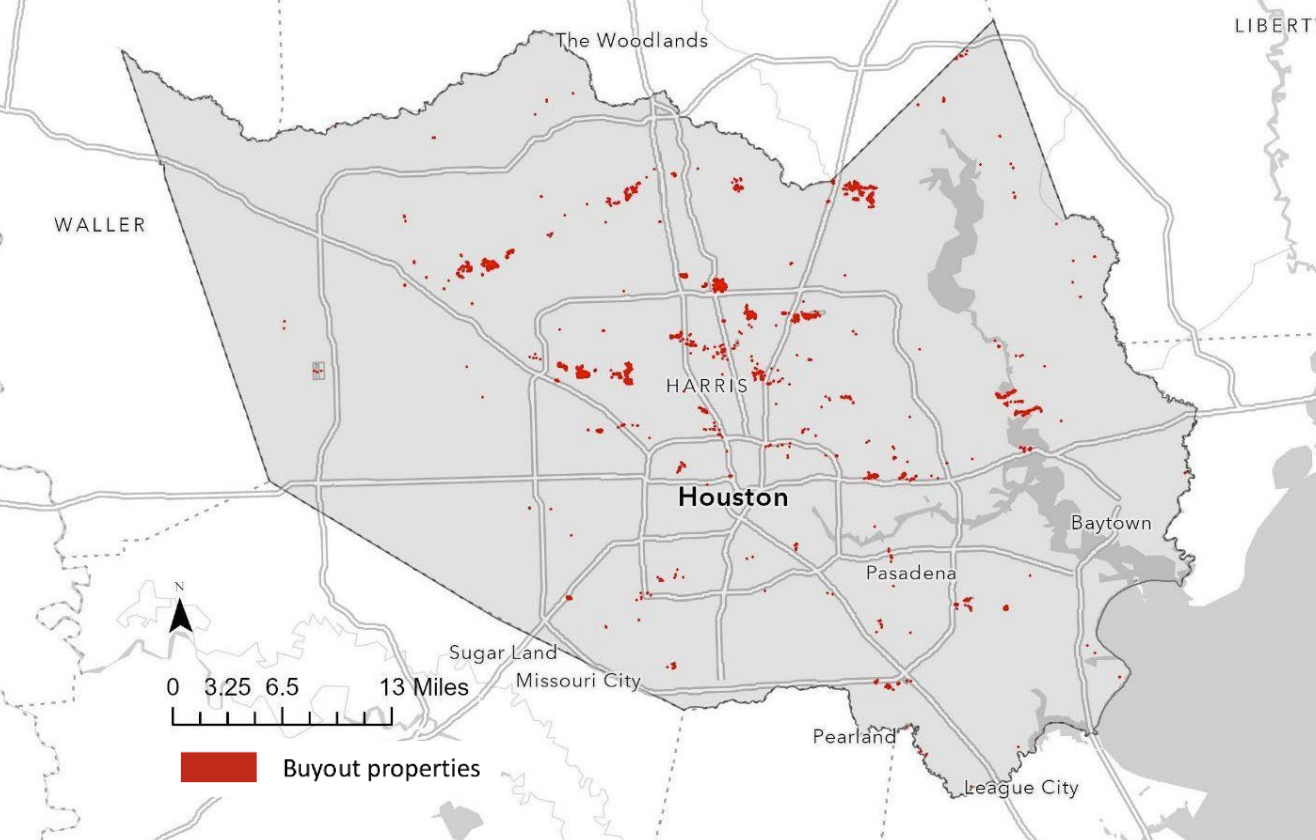
Flood buyouts, green infrastructure, and nearby property values in Harris County, Texas
Team: Ryun Jung Lee, Wayne Day, Alexander Abuabara, Galen Newman, and Walter Peacock
Project period: 2022 – 2023 | Sponsor: Lincoln Institute of Land Policy
This project explores the indirect effects of land-based climate adaptation strategies by measuring the effects of floodplain buyout activity on nearby tax-assessed property values.