


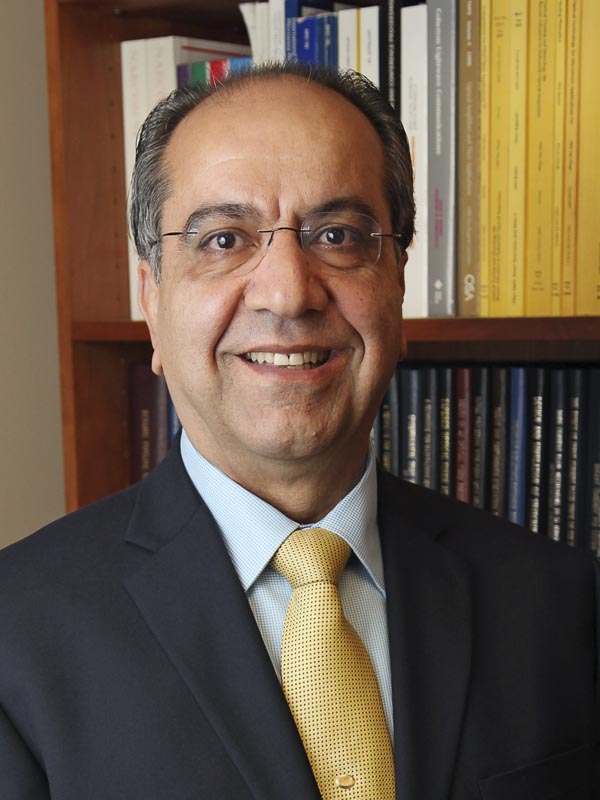
Mehdi Shadaram is the Interim Chair for the COE Civil and Environmental Engineering Department and the Briscoe Distinguished Professor in the Department of Electrical and Computer Engineering.
Please tell us about yourself.
After finishing my undergraduate degree in electrical engineering, I immigrated to the US in 1977 in order to continue my education. After receiving my Ph.D. in 1984, I was hired by the University of Texas at El Paso (UTEP) as a tenure track assistant professor. Eventually, I became an endowed professor and department chair at UTEP. I came to UTSA in 2003 as a distinguished professor and chair of the Electrical and Computer Engineering Department. Since 2007, I have served in different positions as associate dean, center director, and interim dean. Currently, I serve as the interim chair of Civil and Environmental Engineering.
What is your job title and what do you do?
Briscoe Distinguished Professor in the Department of Electrical and Computer Engineering and Interim Chair of Civil and Environmental Engineering.
What brought you to UTSA?
The rapid growth of UTSA.
Tell me about your research and what led you to your field.
My main area of research activity is in the broadband analog and digital fiber optics and wireless communications systems. My involvement in this field ranges from analog and digital photonic devices and fiber optic links to fiber optic sensors. I became interested in this field while I was an undergraduate student in the mid-seventies, when fiber optic systems were being introduced into the market. The idea of photons carrying information for hundreds of kilometers was very fascinating to me. In addition, I have been involved with different aspects of engineering education since I undertook administrative duties.
Were you a first generation or low-income college student?
I was both. My parents did not finish high school. I had six siblings and my mother, a homemaker, had a full-time job taking care of domestic chores. My father had to work six days a week to provide financial support.
If so, what was that like for you? For example, did your family encourage getting a higher degree?
My family was always very supportive. My father particularly encouraged us to continue our education to the highest level.
Did you always feel like you would be able to get into or “make it” in college?
Going to college, particularly in the engineering field, was very competitive when I was young. I knew from an early age that I had to work hard in order to pass the entrance exam to college. When I entered the college, my professors were my role models. I tried to follow their footsteps and I was also very hopeful.
Did you have a good support system in college? How did you overcome any obstacles that may have prevented you from obtaining your Ph.D.?
I have been lucky that I was able to go to college full-time throughout. My undergraduate education was almost free of charge. During my graduate education, I received support such as teaching and research assistantships and some support from family. Also, I had very supportive and helpful faculty advisors. My advisor was very instrumental in securing an internship position for me during my Ph.D. education.
What is your favorite part of your job?
Interacting with students, collaborating with my colleagues, and having the freedom to explore new technological areas that are related to my interest.
How do you define success?
I use the quote from Maya Angelou to define success: “Success is liking yourself, liking what you do, and liking how you do it.”
If you could eat only one thing for the rest of your life, what would it be?
Baked Panzerotti.