


By W. Scott Bailey, Senior Reporter, San Antonio Business Journal
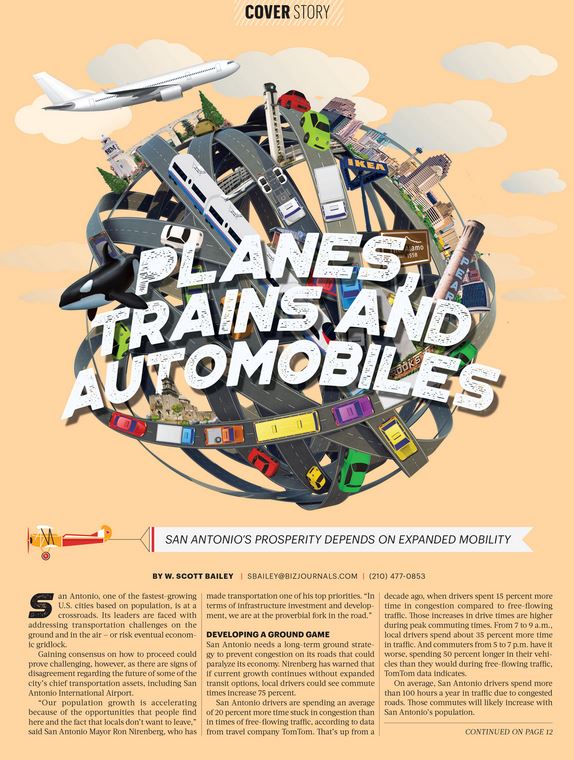
(September 28, 2018) — San Antonio, one of the fastest-growing U.S. cities based on population, is at a crossroads where its leaders are faced with addressing transportation challenges on the ground and in the air — or risk eventual economic gridlock.
Gaining consensus on how to proceed could prove challenging, however, as there are signs of disagreement regarding the future of some of the city’s chief transportation assets, including San Antonio International Airport.
“Our population growth is accelerating because of the opportunities that people find here and the fact that locals don’t want to leave,” said San Antonio Mayor Ron Nirenberg, who has made transportation one of his top priorities.“In terms of infrastructure investment and development, we are at the proverbial fork in the road.”
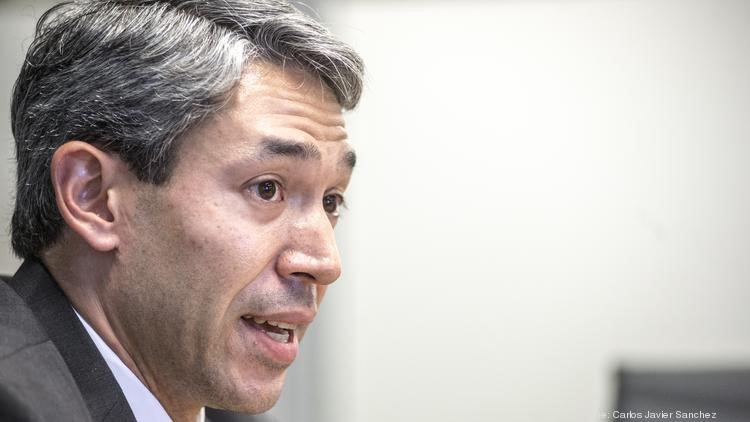
Mayor Ron Nirenberg has made transportation one of his top priorities.
Carlos Javier Sanchez | SABJ
Developing a ground game
San Antonio needs a long-term ground strategy to prevent congestion on its roads that could paralyze its economy. Nirenberg has warned that if current growth continues without expanded transit options, local drivers could see commute times increase 75 percent.
San Antonio drivers are spending an average of 20 percent more time stuck in congestion than in times of free-flowing traffic, according to data from travel company TomTom. That’s up from a decade ago, when drivers spent 15 percent more time in congestion compared to free-flowing traffic. Those increases in drive times are higher during peak commuting times. From 7 to 9 a.m., local drivers spend about 35 percent more time in traffic. And commuters from 5 to 7 p.m. have it worse, spending 50 percent longer in their vehicles than they would during free-flowing traffic, TomTom data indicates.
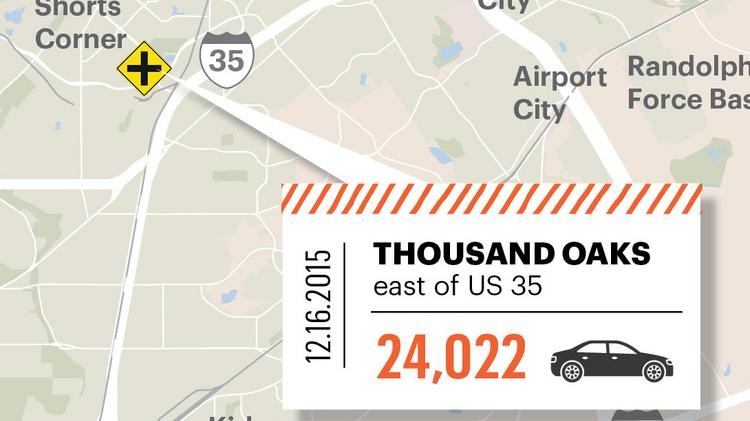
Busy intersections in SA
In order to determine some of the city’s busiest intersections, We chose several busy intersections from the city’s Traffic Counts Query website, which includes the date measured.
On average, San Antonio drivers spend more than 100 hours a year in traffic due to congested roads. Those commutes will likely increase with San Antonio’s population.
VIA Metropolitan Transit has been developing a Vision 2040 Long-Range Transportation Plan to address such concerns. It’s identified several priorities, including the need for more frequent and reliable service, as well as a proposed rapid transit network and increased integration of new technology.
“In fiscal 2018, in partnership with the city, we started a ramp up for more frequent service on nine routes within five corridors,” VIA President and CEO Jeffrey Arndt said. “In January, we will add four more corridors to the frequent network.”
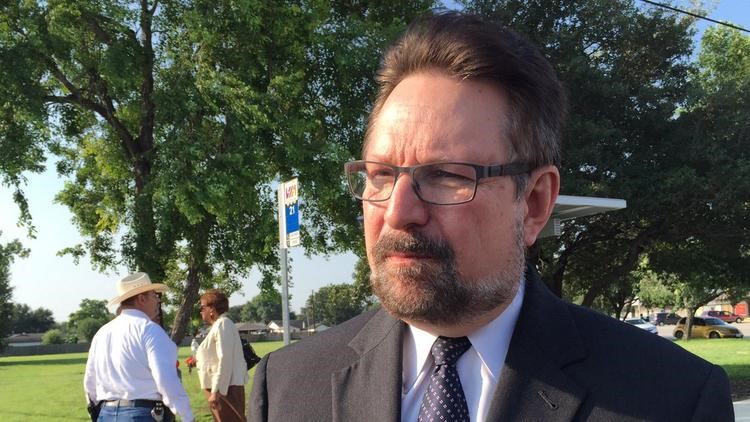
VIA Metropolitan Transit CEO Jeffrey Arndt said trackless trains are among the options being considered to move more people about the city.
Sergio Chapa | SABJ
The routes affected have seen a 30 percent or greater increase in ridership, according to VIA. Arndt said the enhanced service and increased ridership was made possible by funding from Bexar County for capital improvements, including new buses.
VIA is also working to expand its Primo bus service to Brooks and other key hubs in the city, and it’s partnering with ride-hailing companies such as Lyft Inc.
Port San Antonio CEO Jim Perschbach believes there is an opportunity to transform the 1,900-acre site once home to Kelly Air Force Base into a greater economic hub around multiple industries, including cybersecurity. But he said transportation will be critical.
“We have, in San Antonio, some truly deep capabilities in areas that are going to be increasingly important to the global economy in the years and decades to come,” he said. “But we will not be able to take advantage of these capabilities if they cannot connect with each other.”
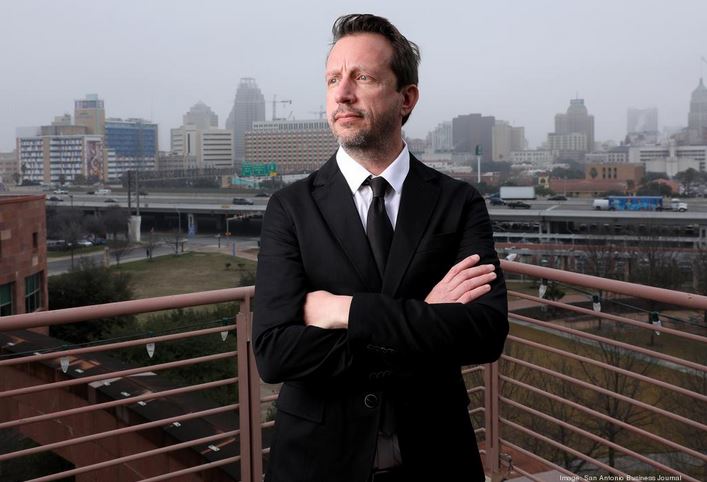
Antonio Petrov is an associate professor at the University of Texas at San Antonio and heads the Urban Future Lab.
Gabe Hernandez | SABJ
Antonio Petrov, an associate professor at the University of Texas at San Antonio who heads the Urban Future Lab, a local think tank and research lab, said the Alamo City should borrow more ideas from cities like Boston, Miami, Chicago, Seattle and Los Angeles, which have moved to embrace trends in public transportation.
“The way we currently look at transportation in San Antonio is very car-centric,” he said. “It not only shows in the growing pains of a city with more traffic and the increase in emissions, but it also becomes a question of the performance of our infrastructural and transportation systems.”
Expanding air connectivity
In 2013, 7.8 million passengers flew into or out of San Antonio International Airport. Last year, the passenger total surpassed 8.6 million. Airport officials said there is a strong potential for the 2018 passenger count to exceed 10 million, which would be a new high mark for the city.
Nirenberg has created the Air Services Development Committee and named Denim Group Principal John Dickson as its chair. That group has undertaken a data-based study to determine whether there is an opportunity to expand San Antonio International Airport or whether a new one should be built elsewhere.
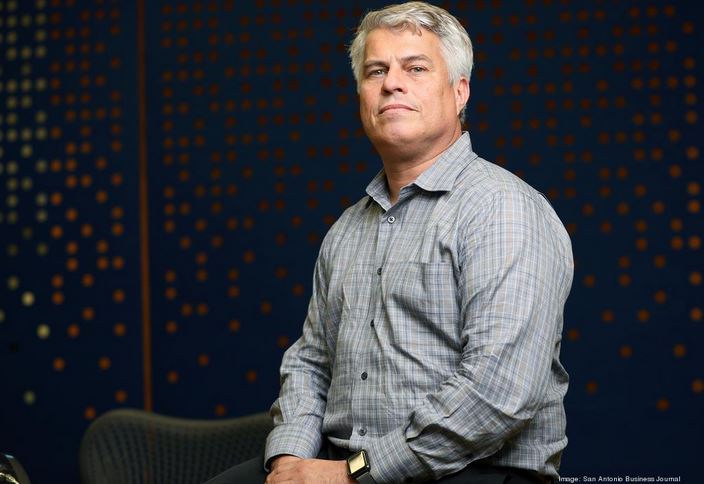
Denim Group Principal John Dickson is heading Mayor Ron Nirenberg’s Air Services Development Committee.
Gabe Hernandez | SABJ
“We have followed a fact-driven process throughout to help answer the question about a new airport footprint versus the existing footprint at San Antonio International,” Dickson said. “We are close to coming up with a recommendation.”
In the interim, former Mayor Henry Cisneros insists the Alamo City needs more serious dialogue about a new airport.
“I’m not saying we have to build it immediately. But if I had a voice, we would begin to plan,” Cisneros said. “I don’t think you can get an up-to-date facility in piecemeal fashion.”
Nirenberg is not ready to look beyond the current facility.
“We all agree on one principle point: San Antonio’s economy needs an internationally competitive airport,” he said. “The disagreement has been where that airport should be and if San Antonio International has a future. My hypothesis has always been that it is a strategic competitive advantage for us to have our international airport in the middle of one of the largest cities in the nation. I believe we will begin to prove up that hypothesis with real data.”
He noted that the city is up about 50 percent in new markets and nonstop flight growth — “an indication our market is demanding more connectivity.”
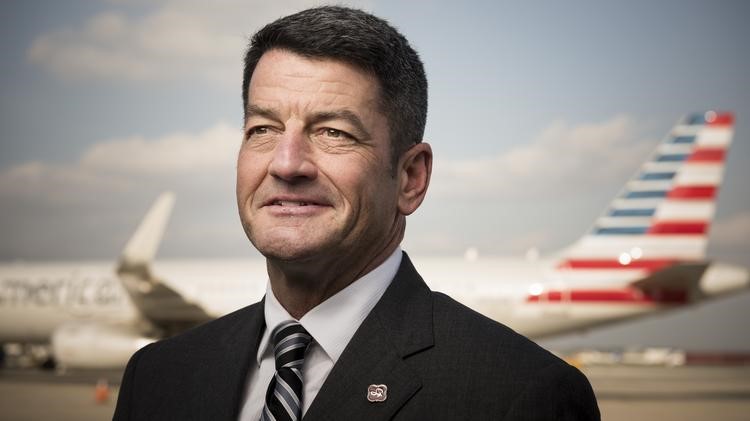
San Antonio Aviation Director Russ Handy said San Antonio International Airport has room to expand.
Carlos Javier Sanchez | SABJ
The increased passenger counts at San Antonio International are a result of efforts by San Antonio Aviation Director Russ Handy and Chief Air Services Development Officer Brian Pratte, among others, who continue to recruit more carriers and nonstop service to the city. Frontier Airlines launched 11 new flights from San Antonio in August.
Asked whether San Antonio International can handle more growth or is in danger of becoming landlocked, Handy was generally confident that it has room to grow.
“The short answer is we have significant space to expand in the key areas where we are nearing capacity,” he said.
At the same time, he said the question is complex, involving more than terminals, and that the city will “carefully examine what the limits are going forward and how to optimize our real estate.”
Moving outside the box
San Antonio was once more aggressive in its approach to transportation. It introduced some of the first electric street cars well over a century ago. The city was home to two skyrides. And it built a monorail system that moved millions of visitors at HemisFair 50 years ago.
Now, one of the city’s more unique modes of alternative transportation are electric scooters, seemingly available on every downtown street. But there are more potentially groundbreaking ideas in the works.
Bus rapid transit is one element VIA is exploring as part of a “comprehensive operational analysis,” said Arndt, who has cited so-called trackless trains as a variation of such a system to consider in San Antonio. The electric trains could operate autonomously and would not run on rail. Instead, they would follow virtual tracks on dedicated roads.
“The advantage is that we could open it with articulated buses,” Arndt said. “And as the technology of the trackless train improves, we could introduce connected automated vehicle platoons.”
VIA officials are optimistic that, over the next three to five years, either trackless train technology will prove workable or another high-capacity transit option could be deployed.
“Whether it’s trackless trains or more micro transportation, the important thing is we need to have options. And those options need to be on right of way that’s dedicated separately from automotive traffic,” Nirenberg said.
Petrov and his team have proposed other ideas, including a public skybus transit system that would carry riders along Broadway Street from the airport to downtown.
“At stake is more than a ground transportation strategy,” he said. “There needs to be a more holistic approach in the way we reimagine existing systems.”
Read “Ground to Air” on the San Antonio Business Journal’s website.
Content retrieved from: http://cacp.utsa.edu/news/ground-to-air-san-antonios-prosperity-depends-on-expanded-mobility.