

myUTSAUTSA TodayVisitDirectorySearch

Klesse College of Engineering and Integrated DesignKlesse College of Engineering and Integrated Design

  • About CEID
    • Dean’s Message
    • Calendar
    • News & Announcements
    • Faculty & Staff
      • Business Service Center
      • CEID Organizational Chart
      • Research Support
      • Resources for Faculty
        • Policies
        • Forms
        • College Committees
      • CEID Vision and Policies
    • Accreditation
    • Visit Us
    • Contact
  • Students
    • Student Success Center
    • Signature Experiences (INTERESTS)
    • Certificate Programs
    • Klesse College Summer Bridge Program
    • Tech Symposium
    • Computer Requirements
    • Graduate Program Ambassadors
  • Research
    • Centers
    • Facilities
    • Graduate Student Funding
  • Undergraduate
    • Overview
    • Admissions
    • Advising Center
    • Degrees Offered
    • Forms
    • Resources
    • Scholarships
      • Other Scholarships
    • Student Success Center
  • Graduate
    • Overview
    • Admissions
    • Certificate Program
    • Master’s Degrees
    • Doctoral Degrees
    • Graduate Scholarships
      • Other Scholarships
    • Resources
  • Disciplines
    • School of Architecture & Planning
    • Department of Biomedical Engineering & Chemical Engineering
      • Biomedical Engineering
      • Chemical Engineering
      • Engineering Education
    • School of Civil & Environmental Engineering, and Construction Management
    • Department of Electrical & Computer Engineering
    • Department of Mechanical Engineering
  • Advisory Council
    • Advisory Council News and Announcements
    • Advisory Council Leadership: Fast Facts
    • Advisory Council Service Expectations
    • Advisory Council Bylaws
    • Advisory Council Minutes
  • Student Support
    • College of Engineering Virtual Tour
    • Make a Gift
 January 20, 2026

Faculty Spotlight: Mehdi Shadaram

Faculty Spotlight: Mehdi Shadaram

by utsaengineer / Tuesday, 14 January 2020 / Published in UTSA COE

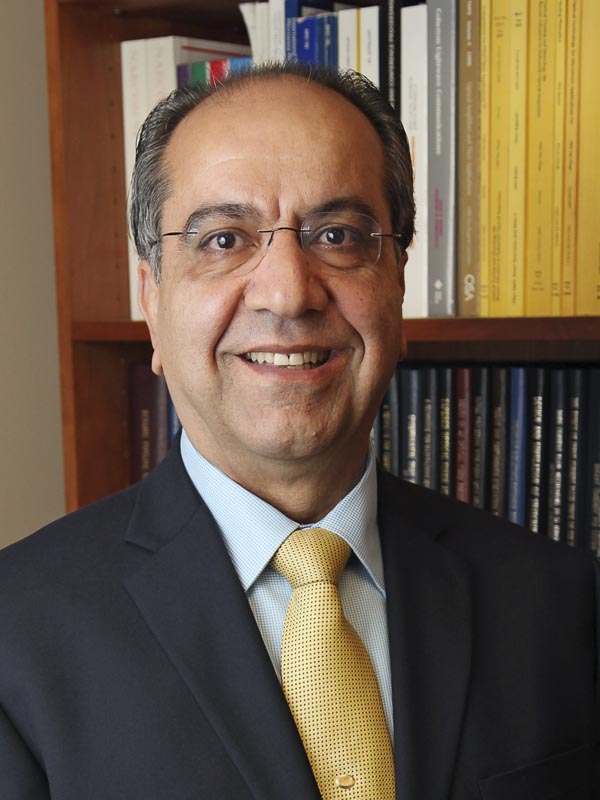
Mehdi Shadaram is the Interim Chair for the COE Civil and Environmental Engineering Department and the Briscoe Distinguished Professor in the Department of Electrical and Computer Engineering.

Please tell us about yourself.
After finishing my undergraduate degree in electrical engineering, I immigrated to the US in 1977 in order to continue my education. After receiving my Ph.D. in 1984, I was hired by the University of Texas at El Paso (UTEP) as a tenure track assistant professor. Eventually, I became an endowed professor and department chair at UTEP. I came to UTSA in 2003 as a distinguished professor and chair of the Electrical and Computer Engineering Department. Since 2007, I have served in different positions as associate dean, center director, and interim dean. Currently, I serve as the interim chair of Civil and Environmental Engineering.

What is your job title and what do you do?
Briscoe Distinguished Professor in the Department of Electrical and Computer Engineering and Interim Chair of Civil and Environmental Engineering.

What brought you to UTSA?
The rapid growth of UTSA.

Tell me about your research and what led you to your field.
My main area of research activity is in the broadband analog and digital fiber optics and wireless communications systems. My involvement in this field ranges from analog and digital photonic devices and fiber optic links to fiber optic sensors. I became interested in this field while I was an undergraduate student in the mid-seventies, when fiber optic systems were being introduced into the market. The idea of photons carrying information for hundreds of kilometers was very fascinating to me. In addition, I have been involved with different aspects of engineering education since I undertook administrative duties.

Were you a first generation or low-income college student?
I was both. My parents did not finish high school. I had six siblings and my mother, a homemaker, had a full-time job taking care of domestic chores. My father had to work six days a week to provide financial support.

If so, what was that like for you? For example, did your family encourage getting a higher degree?
My family was always very supportive. My father particularly encouraged us to continue our education to the highest level.

Did you always feel like you would be able to get into or “make it” in college?
Going to college, particularly in the engineering field, was very competitive when I was young. I knew from an early age that I had to work hard in order to pass the entrance exam to college. When I entered the college, my professors were my role models. I tried to follow their footsteps and I was also very hopeful.

Did you have a good support system in college? How did you overcome any obstacles that may have prevented you from obtaining your Ph.D.?
I have been lucky that I was able to go to college full-time throughout. My undergraduate education was almost free of charge. During my graduate education, I received support such as teaching and research assistantships and some support from family. Also, I had very supportive and helpful faculty advisors. My advisor was very instrumental in securing an internship position for me during my Ph.D. education.

What is your favorite part of your job?
Interacting with students, collaborating with my colleagues, and having the freedom to explore new technological areas that are related to my interest.

How do you define success?
I use the quote from Maya Angelou to define success: “Success is liking yourself, liking what you do, and liking how you do it.”

If you could eat only one thing for the rest of your life, what would it be?
Baked Panzerotti.


Categories

  • Biomedical Engineering
  • CACP
  • Civil and Environmental Engineering
  • COE Announcements
  • Electrical and Computer Engineering
  • General
  • Highlights
  • Innovation Magazine
  • Mechanical Announcements
  • Mechanical Engineering
  • News
  • Uncategorized
  • UTSA COE

Recent Posts

  • Klesse College Logo

    UTSA researchers secure funding through NSF’s Future of Work at the Human-Technology Frontier project

    September 27, 2022 – Three faculty members of t...
  • Ibukun Awolusi

    The Klesse College’s Ibukun Awolusi receives Digital Technologies for Steel Manufacturing Grant

    September 09, 2022 – The Association for ...
  • Klesse College Logo

    The Klesse College announces inaugural Professorships and Fellowships

    September 1, 2022 – Today, the Margie and...
  • Klesse College Logo

    The Klesse College announces faculty promotions

    August 30, 2022 – The UT System Board of ...
  • John "Jack" Simonis

    Remembering John “Jack” Simonis

    August 19, 2022 – The Margie and Bill Kle...

Archives

  • September 2022
  • August 2022
  • May 2022
  • April 2022
  • March 2022
  • February 2022
  • January 2022
  • December 2021
  • November 2021
  • October 2021
  • September 2021
  • August 2021
  • July 2021
  • June 2021
  • May 2021
  • April 2021
  • December 2020
  • November 2020
  • September 2020
  • June 2020
  • May 2020
  • April 2020
  • March 2020
  • February 2020
  • January 2020
  • December 2019
  • November 2019
  • October 2019
  • September 2019
  • August 2019
  • July 2019
  • June 2019
  • May 2019
  • April 2019
  • March 2019
  • February 2019
  • January 2019
  • December 2018
  • November 2018
  • October 2018
  • September 2018
  • August 2018
  • July 2018
  • June 2018
  • April 2018
  • February 2018
  • January 2018
  • December 2017
  • November 2017
  • October 2017
  • September 2017
  • July 2017
  • February 2017

Margie and Bill Klesse College of Engineering and Integrated Design (Klesse College)

BSE Building, Room 2.106
One UTSA Circle
San Antonio, TX 78249
Phone: 210-458-4490
Fax: 210-458-5515

Contact Klesse College Webmaster
Klesse College Employment

UTSA Mission
The University of Texas at San Antonio is dedicated to the advancement of knowledge through research and discovery, teaching and learning, community engagement and public service. As an institution of access and excellence, UTSA embraces multicultural traditions and serves as a center for intellectual and creative resources as well as a catalyst for socioeconomic development and the commercialization of intellectual property – for Texas, the nation and the world.

UTSA Vision
To be a premier public research university, providing access to educational excellence and preparing citizen leaders for the global environment.

© 2021 The University of Texas at San Antonio | One UTSA Circle San Antonio, TX 78249 | Information 210-458-4011
Campus Alerts | Jobs | Required Links | Policies | UT System | Report Fraud
Produced by University Communications and Marketing

TOP