

myUTSAUTSA TodayVisitDirectorySearch

Klesse College of Engineering and Integrated DesignKlesse College of Engineering and Integrated Design

  • About CEID
    • Dean’s Message
    • Calendar
    • News & Announcements
    • Faculty & Staff
      • Business Service Center
      • CEID Organizational Chart
      • Research Support
      • Resources for Faculty
        • Policies
        • Forms
        • College Committees
      • CEID Vision and Policies
    • Accreditation
    • Visit Us
    • Contact
  • Students
    • Student Success Center
    • Signature Experiences (INTERESTS)
    • Certificate Programs
    • Klesse College Summer Bridge Program
    • Tech Symposium
    • Computer Requirements
    • Graduate Program Ambassadors
  • Research
    • Centers
    • Facilities
    • Graduate Student Funding
  • Undergraduate
    • Overview
    • Admissions
    • Advising Center
    • Degrees Offered
    • Forms
    • Resources
    • Scholarships
      • Other Scholarships
    • Student Success Center
  • Graduate
    • Overview
    • Admissions
    • Certificate Program
    • Master’s Degrees
    • Doctoral Degrees
    • Graduate Scholarships
      • Other Scholarships
    • Resources
  • Disciplines
    • School of Architecture & Planning
    • Department of Biomedical Engineering & Chemical Engineering
      • Biomedical Engineering
      • Chemical Engineering
      • Engineering Education
    • School of Civil & Environmental Engineering, and Construction Management
    • Department of Electrical & Computer Engineering
    • Department of Mechanical Engineering
  • Advisory Council
    • Advisory Council News and Announcements
    • Advisory Council Leadership: Fast Facts
    • Advisory Council Service Expectations
    • Advisory Council Bylaws
    • Advisory Council Minutes
  • Student Support
    • College of Engineering Virtual Tour
    • Make a Gift
 January 20, 2026

Q&A: Mohammadali Sharzehee: Grad student research helps keep hearts flowing

Q&A: Mohammadali Sharzehee: Grad student research helps keep hearts flowing

by utsaengineer / Tuesday, 15 January 2019 / Published in Biomedical Engineering, COE Announcements, Mechanical Engineering, News, UTSA COE

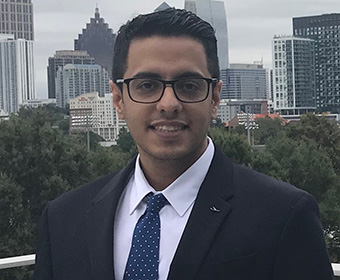
(Jan. 15, 2019) — Mohammadali Sharzehee is a doctoral student in the UTSA Department of Mechanical Engineering who studies cardiovascular mechanics and builds computer simulations to understand how blood vessels operate under adverse conditions that lead to cardiovascular diseases.

In 2017, Sharzehee moved from Iran to the United States and started his Ph.D. program at UTSA. He found quick success and a few months later published an analysis in the Journal of Computer Methods in Biomechanics and Biomedical Engineering of how arteries, the blood vessels that carry oxygen-rich blood from the heart, lose their resiliency and lead to aneurysms.

UTSA Today spoke to Sharzehee about his “tubular” work:

Why do you study a field that combines engineering but also the human body?

Cardiovascular biomechanics is a fast-growing field of engineering and improves the understanding, treatment and prevention of cardiovascular diseases. It also plays a crucial role in the development of the medical devices by applying mechanical engineering principles to cardiovascular system.

You focus on how arteries in our bodies twist into loops and spirals during negative conditions. Why do you want to study this field?

Vascular tortuosity or twists may result in an ischemic attack—a restriction in blood supply—to distal organs as well as other negative changes related to diseases. This research has an important impact on clinical work and, because of that, I became motivated to better understand the mechanisms of arteries.

What does your work intend to show?

My work aims to determine the biomechanical loads or conditions that trigger the occurrence of tortuous blood vessels using computational modeling. In addition, my results illustrate the effects of vessel dimensions, material models and properties, and mechanical loadings conditions on formation of tortuous vessels—curving, coiling, kinking and looping.

How is your research beneficial to people?

Our computational model can be applied to any tubular organ, including the esophagus and the stomach, and even vascular implants including grafts and stents. Considering the torsional and bending stability of blood vessels and vascular grafts, this is important for future designs of vascular implant and treatments in vascular disease.

How did you get into this type of research? Was there a turning point — an “a ha” moment?

Our research group, under the supervision of Dr. Hai-Chao Han, has conducted a number of artery buckling experiments. During those experiments, we observed tortuous vessels but the “how” or the mechanics of artery helical buckling remained unclear. Dr. Han explained the problem to me, and I decided solve the question with computational modeling. After one year of hard work, we have finally completed the work and submitted our manuscript to peer-reviewed journals.

Why did you choose UTSA?

I chose UTSA to work with Dr. Han, whose research piqued my interest. I believe that his guidance will pave the way for my future academic success.

What keeps you up at night?

Despite grueling and frustrating work, my enthusiasm for academic research to make scientific breakthroughs keeps me motivated during my Ph.D.

What’s next?

Currently, I am working on another cardiovascular disease (myocardial bridge) in which a segment of the coronary artery is covered by a muscle bridge that can lead to transient vessel compression. I want to enhance the understanding and treatment of this disease to improve the quality of life for people.

– Milady Nazir

Categories

  • Biomedical Engineering
  • CACP
  • Civil and Environmental Engineering
  • COE Announcements
  • Electrical and Computer Engineering
  • General
  • Highlights
  • Innovation Magazine
  • Mechanical Announcements
  • Mechanical Engineering
  • News
  • Uncategorized
  • UTSA COE

Recent Posts

  • Klesse College Logo

    UTSA researchers secure funding through NSF’s Future of Work at the Human-Technology Frontier project

    September 27, 2022 – Three faculty members of t...
  • Ibukun Awolusi

    The Klesse College’s Ibukun Awolusi receives Digital Technologies for Steel Manufacturing Grant

    September 09, 2022 – The Association for ...
  • Klesse College Logo

    The Klesse College announces inaugural Professorships and Fellowships

    September 1, 2022 – Today, the Margie and...
  • Klesse College Logo

    The Klesse College announces faculty promotions

    August 30, 2022 – The UT System Board of ...
  • John "Jack" Simonis

    Remembering John “Jack” Simonis

    August 19, 2022 – The Margie and Bill Kle...

Archives

  • September 2022
  • August 2022
  • May 2022
  • April 2022
  • March 2022
  • February 2022
  • January 2022
  • December 2021
  • November 2021
  • October 2021
  • September 2021
  • August 2021
  • July 2021
  • June 2021
  • May 2021
  • April 2021
  • December 2020
  • November 2020
  • September 2020
  • June 2020
  • May 2020
  • April 2020
  • March 2020
  • February 2020
  • January 2020
  • December 2019
  • November 2019
  • October 2019
  • September 2019
  • August 2019
  • July 2019
  • June 2019
  • May 2019
  • April 2019
  • March 2019
  • February 2019
  • January 2019
  • December 2018
  • November 2018
  • October 2018
  • September 2018
  • August 2018
  • July 2018
  • June 2018
  • April 2018
  • February 2018
  • January 2018
  • December 2017
  • November 2017
  • October 2017
  • September 2017
  • July 2017
  • February 2017

Margie and Bill Klesse College of Engineering and Integrated Design (Klesse College)

BSE Building, Room 2.106
One UTSA Circle
San Antonio, TX 78249
Phone: 210-458-4490
Fax: 210-458-5515

Contact Klesse College Webmaster
Klesse College Employment

UTSA Mission
The University of Texas at San Antonio is dedicated to the advancement of knowledge through research and discovery, teaching and learning, community engagement and public service. As an institution of access and excellence, UTSA embraces multicultural traditions and serves as a center for intellectual and creative resources as well as a catalyst for socioeconomic development and the commercialization of intellectual property – for Texas, the nation and the world.

UTSA Vision
To be a premier public research university, providing access to educational excellence and preparing citizen leaders for the global environment.

© 2021 The University of Texas at San Antonio | One UTSA Circle San Antonio, TX 78249 | Information 210-458-4011
Campus Alerts | Jobs | Required Links | Policies | UT System | Report Fraud
Produced by University Communications and Marketing

TOP